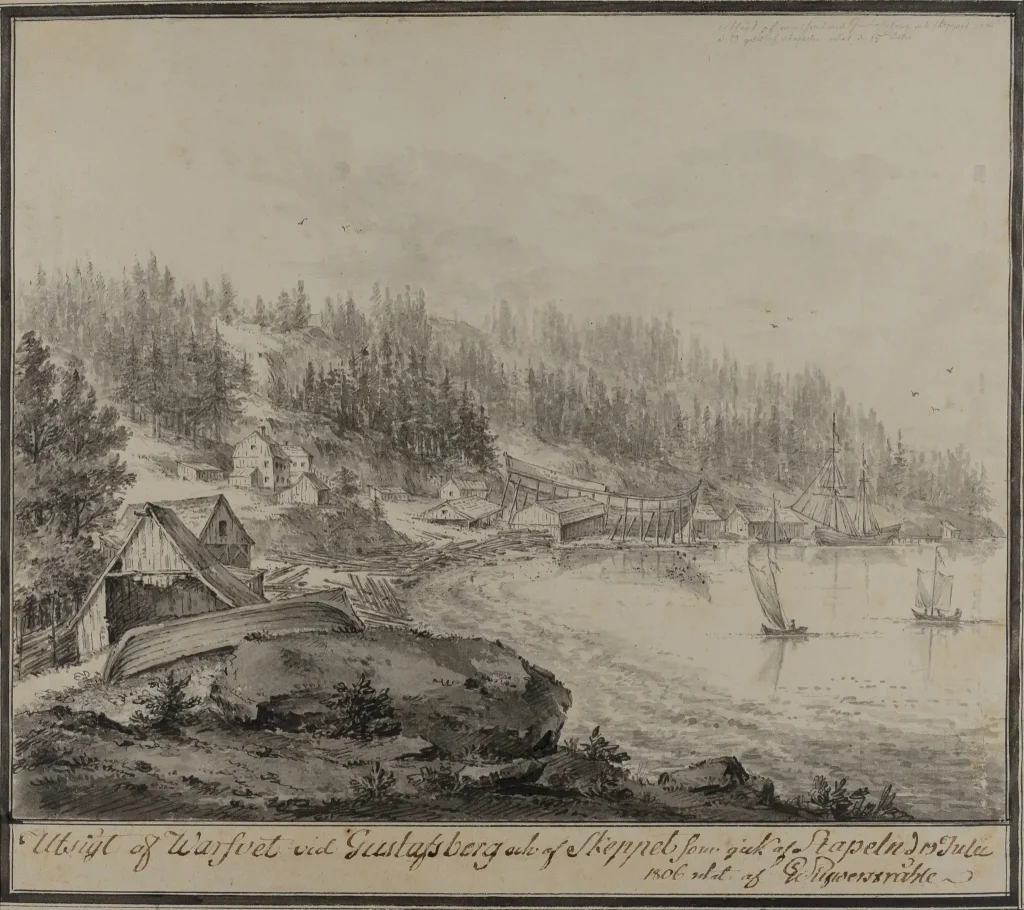
Welcome to Gustafsberg
Sweden’s oldest seaside resort and first boarding school

Uddevalla-born Anders Knape Hanson purchased the Baggetofta estate south of the town in 1766. In 1772, he and his wife Catharina Hegardt established a foundation to provide a home and education for talented boys in need from Bohuslän. The wealthy couple had no children of their own. Anders Knape had made his fortune through trade and shipping.
After Gustav III approved Knape’s foundation in 1774, Baggetofta was renamed Gustafsberg. The boarding school opened in 1776 as the Gustafsberg Children’s Home.
The school remained in operation until 1924. After a 25-year break, a residential school opened in 1949 for boys who studied in Uddevalla and lived at Gustafsberg. Exactly 200 years after Anders Knape Hanson founded the children’s home, the residential school closed in 1976.
The donor’s wish to “promote the education and upbringing of young people” is now upheld through scholarships awarded by the Gustafsberg Foundation to talented boys and girls.
By the late 17th century, taking the waters had become fashionable. People followed an organised regimen of drinking mineral-rich water from health springs. The Baggetofta estate had such a spring, and in 1729 the Gothenburg physician Jacob Boëthius was commissioned to examine its water. He found it excellent and rich in beneficial minerals.
Taking the waters, combined with various forms of bathing, became common during the 18th and 19th centuries. Gustafsberg’s position beside salt water, surrounded by hills and lush greenery, made it popular. Sea bathing from rafts in the bay began early, and Gustafsberg may therefore be regarded as Sweden’s first seaside resort.
Gustafsberg’s great rise in popularity began when Gustav IV Adolf and Queen Frederica brought their sickly son, Crown Prince Gustav, to bathe here in June 1804. The prince recovered after the salt-water baths, and visitors flocked to the resort.
The board of the children’s home responded to the interest by building two warm bathhouses in 1814. Stora Varmbadhuset was the more elegant, while Lilla Varmbadhuset, now Sjöstugan, beside the steamboat pier served poorer bathers.
When the two bathhouses were completed, Gustafsberg again received royal visitors: Karl XIII and his consort Hedvig Elisabeth Charlotte, together with Sweden’s newly elected Crown Prince Karl Johan. The queen spent six summer weeks taking beneficial baths. The king and crown prince left on a campaign against Norway that resulted in the union between Sweden and Norway, which lasted until 1905.
By the 1830s, Gustafsberg was the resort everyone wanted to visit. Celebrities of the period, including Fredrika Bremer, Esaias Tegnér, Malla Silfverstolpe, August Blanche, Lars Johan Hierta and Erik Gustaf Geijer, signed the guest book.

In addition to taking the waters and healthy baths, guests spent their days walking and conversing. In the evenings, they enjoyed musical soirées, theatrical performances and balls in Societetshuset.
Spa life changed character during the second half of the 19th century and became more of a summer pastime for the middle classes. New transport links, such as the Uddevalla-Herrljunga railway, made the resort easier to reach. By the early 20th century, visits had become more sporting, with sailing regattas and bathing directly in the sea.
At Gustafsberg, you can stay, eat, walk, explore or simply be…
Gustafsberg can be visited throughout the year, and its beauty changes with the seasons.
The area is of national cultural-historical importance and contains many beautiful buildings, 26 of which are protected historic monuments.
Several Gustafsberg houses were built as guest houses for distinguished summer visitors. You too are welcome to stay with us and experience the presence of history.
Book at gustafsberg.se.
Information signs around the grounds tell Gustafsberg’s many stories. Their locations are marked on the map, and the information is also available on our website.
Take an invigorating walk along the paths in the nature reserve. Enjoy a warm swim in summer, have an ice cream or two, take a cold dip at Sörkullen’s winter bathing area, and warm up with lunch at one of Gustafsberg’s restaurants.
The health spring is accessible on certain occasions. Take the opportunity to drink the waters and participate in a 300-year-old tradition.